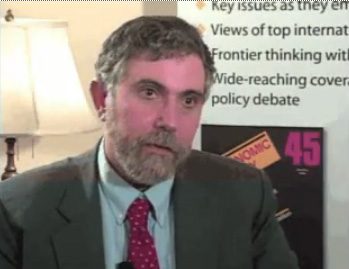
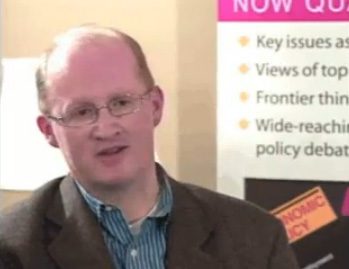
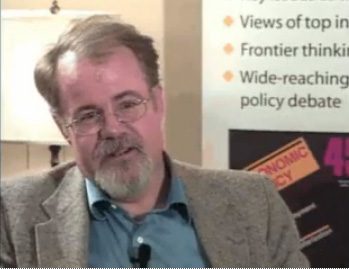
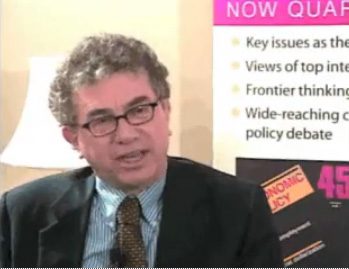
In February, Economic Policy organized a special Panel Meeting, hosted by the Federal Reserve Bank of New York, to discuss the very pressing issue of global imbalances and the fundamental question of foreign aid. The meeting brought together some of the world’s foremost thinkers on these matters, including Jeffrey Frankel, Paul Krugman, Philip Lane and Bill Easterly. A lively debate followed the presentations of each of these preeminent speakers, as participants focussed not only on defining the issues, but on what can be done to alleviate or improve them. Some of these thoughts were captured on film, in a series of short interviews, presented here on the Economic Policy site for the first time. We hope you will enjoy them.
Interviews with presenters
[brightcove videoID=2234252791001 playerID=904926353001 height=332 width=590]
Jeffrey Frankel interviewed by Georges de Menil
on the Renminbi and global imbalances
(13min, 52secs)
What is the role of the Renminbi in the imbalances that have built up between China and the US? The exchange rate is not at the root of the problem, argues Frankel: “the US trade deficit is not China’s fault”, it is instead a result of the exceptionally low US savings rate. But the Renminbi could be part of the answer, which is in the interest of both China and the US. And given the stakes at hand, maybe it should be the role of the IMF to oversee an agreement or at least the drafting of a contingency plan.
[brightcove videoID=2234235431001 playerID=904926353001 height=332 width=590]
Paul Krugman interviewed by Georges de Menil
on financial markets and global imbalances
(15min, 32secs)
Have things really improved since the early days of experimentation with open capital markets and floating exchange rates? Not really, suggests Krugman. Market participants – the real drivers of short to medium run trends – are characterized by bounded rationality, mainly because “it doesn’t pay to think of the sustainability of the US deficit”. “Markets go for long periods where they appear to be defying fundamentals… I think that is what is happening in the case of the dollar right now,” argues Krugman, while still thinking ahead: how likely is a crash of the dollar and what circumstances could mitigate its effects?
[brightcove videoID=2234240575001 playerID=904926353001 height=332 width=590]
Philip Lane interviewed by Richard Portes
on Europe and global imbalances
(15min, 3secs)
“The EU, although it trades a lot with the world, is primarily an internally focussed economy,” argues Lane. Unfortunately, given the EU’s recent history of small, separate states, that is not a common realization among politicians who continue to focus on questions of exchange rates rather than worry about domestic-driven growth and reforms. Even a sudden and large depreciation of the dollar would leave the EU relatively unscathed, as its direct exposure to the dollar is limited in its trade and financial portfolios.
[brightcove videoID=2234252788001 playerID=904926353001 height=332 width=590]
William Easterly interviewed by Georges de Menil
on the effectiveness of foreign aid
(24min, 32secs)
“No-one is ever individually accountable for anything” in the world of foreign aid, argues Easterly. And that is the biggest problem. Haven’t we learned in economics that collective responsibility doesn’t work? That good performance needs to be rewarded and poor performance penalized? And that goals should be measurable and attainable? Yet, these simple lessons are nowhere to be seen in the development world. A rethinking of aid along these lines is necessary and could lead to a multitude of small, incremental yet very tangible and immensely useful improvements. Let’s start with that; economic growth and development “can [anyhow] probably only be done by the poor people themselves.”
Draft papers presented
Hosted by the Federal Reserve Bank of New York
New York, 12 February 2007
Assessing China’s Exchange Rate Regime
Jeffrey Frankel (Harvard University)
Discussants:
Linda Goldberg (Federal Reserve Bank of New York)
Nouriel Roubini (New York University)
Are Aid Agencies Improving?
William Easterly (New York University)
Discussants:
Allan Drazen (University of Maryland)
Raquel Fernandez (New York University)
Europe and Global Imbalances
Philip R Lane (IIIS, Trinity College Dublin)
Gian Maria Milesi-Ferretti (IMF)
Discussants:
Paolo Pesenti (Federal Reserve Bank of New York)
Federico Sturzenegger (Harvard University and Universidad Torcuato di Tella)
Will There Be a Dollar Crisis?
Paul Krugman (Princeton University)
Discussants:
Giancarlo Corsetti (European University Institute)
Kevin O’Rourke (Trinity College, Dublin) – written discussion
Global Imbalances or Bad Accounting? The Missing Dark Matter in the Wealth of Nations
Ricardo Hausmann (Harvard University)
Federico Sturzenegger (Harvard University and Universidad Torcuato di Tella)
Discussants:
Cedric Tille (Federal Reserve Bank of New York)
Anne Sibert (Birkbeck College) – written discussion