Improving the SGP through a proper accounting of public investment
Olivier Blanchard
MIT
Francesco Giavazzi
Bocconi

Olivier Blanchard
MIT
Francesco Giavazzi
Bocconi
Pierre Cahuc
Stéphane Carcillo
Patrick Honohan
The World Bank and CEPR
Philip R. Lane
Economics Department and IIIS, Trinity College Dublin and CEPR
Kenneth Rogoff
Richard K. Lyons
Economic Policy celebrated its 20th anniversary at the Bank of England with a special Panel Meeting and dinner in October 2005. Governor Mervyn King, author of a paper published in the inaugural issue in 1985, gave the opening address while Chief Economist Charles Bean, who served on the first editorial team, was a keynote speaker.
Other top economists from around the world joined them in a lively and incisive debate on current policy issues, fuelled by eight paper presentations on topics as diverse as the international monetary system, higher education and road pricing. Senior editors, managing editors, panel members and members of the press were joined by a number of distinguished guests. Among them past editors and authors including David Begg (Imperial College), Olivier Blanchard (MIT), Barry Eichengreen (UCB), Stephen Nickell (LSE) and Charles Wyplosz (HEI, Geneva).
The following papers were presented at the October 2005 20th Anniversary Panel Meeting at the Bank of England; they appear below in their final version, as printed in Economic Policy.
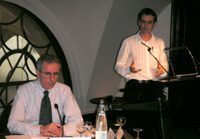 |
Price Setting and Inflation Persistence Ignazio Angeloni (Ministero dell’Economia e delle Finanze), Luc Aucremanne (National Bank of Belgium) and Matteo Ciccarelli (European Central Bank) Discussion (PDF): Hélène Rey Discussion (PDF): Pierre Cahuc |
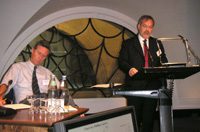 |
European Unemployment: The Evolution of Facts and Ideas Olivier Blanchard (Massachusetts Institute of Technology) Discussion (PDF): Charles Bean |
 |
Has the Inflation Process Changed? Guy Debelle (Reserve Bank of Australia) and Steve Cecchetti (Brandeis University) Discussion (PDF): Manuel Arellano |
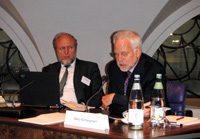 |
The International Monetary System in the last (and next) 20 years Barry Eichengreen (University of California Berkeley and CEPR) and Raul Razo-Garcia (University of California Berkeley) Discussion (PDF): Giancarlo Corsetti |
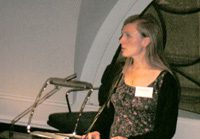 |
Road Pricing: Lessons from London Gordon Fraser (University of Cambridge) and Georgina Santos (University of Oxford) Discussion (PDF): Neil Gandal Discussion (PDF): David Newbery |
 |
Guide to Reform of Higher Education: a European Perspective Bas Jacobs (University of Amsterdam) and Frederick van der Ploeg (European University Institute and CEPR) Discussion (PDF): Esther Duflo Discussion (PDF): Pierre Pestieau |
 |
Improving Fiscal Policy in the EU. The Case for Independent Forecasts Lars Jonung (European Commission) and Martin Larch (European Commission) Discussion (PDF): Carlo Favero Discussion (PDF): Philippe Martin |
 |
Competition Economics and Antitrust in Europe Damien J. Neven (Graduate Institute of International Studies and CEPR) Presentation (PDF): Damien J. Neven |
 |
European Monetary Union: The Dark Sides of a Major Success Charles Wyplosz (Graduate Institute of International Studies and CEPR) Discussion (PDF): Stephen Nickell |
Download a summary of the discussions that followed each paper presentation.
 |
 |
 |
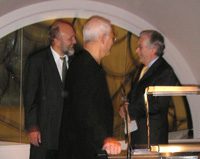
(Left) Hans-Werner Sinn and Richard Portes exchanging a joke with Mervyn King.
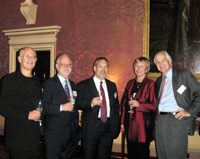
(Middle) Enjoying good company: Richard Portes, David Begg, Charles Bean, Jenny Holland, Georges de Ménil.
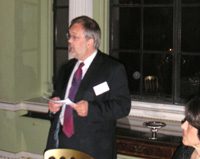
(Right) Charles Bean speaking at dinner.
 |
 |
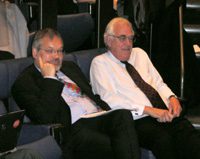 |
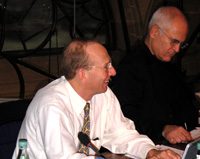
(Left) Current and past editors mingle: Barry Eichengreen, Richard Baldwin, David Begg, Paul Seabright, Olivier Blanchard.
(Middle) Economics can certainly be fun: Richard Baldwin and Richard Portes.
(Right) Colleagues at LSE and the Bank of England, Charles Bean and Steven Nickell relax between presentations.
We’ve pulled together a collection of articles reflecting on the range of analysis on the Global Financial and Eurozone crises appearing in Economic Policy over the last 5 years. Edited by Thorsten Beck, this virtual issue focuses on one of the most acute contemporary challenges to economic policy and how the journal has contributed to our understanding of the European experience.
Visit the OUP website to read the Economic Policy ‘Financial Crisis’ virtual issue
Cyprus: from boom to bail-in
Alexander Michaelides (2014) 29 (80): 639-689
The Greek debt restructuring: an autopsy
Jeromin Zettelmeyer, Christoph Trebesch, Mitu Gulati (2013) 28 (75): 513-563
External imbalances in the eurozone
Ruo Chen, Gian Maria Milesi-Ferretti, Thierry Tressel (2013) 28 (73): 101-142
The eurozone crisis: how banks and sovereigns came to be joined at the hip
Ashoka Mody, Damiano Sandri (2012) 27 (70): 199-230
From Great Depression to Great Credit Crisis: similarities, differences and lessons
Miguel Almunia, Agustín Bénétrix, Barry Eichengreen, Kevin H. O’Rourke, Gisela Rua (2010) 25 (62): 219-265
Lessons from a collapse of a financial system
Sigridur Benediktsdottir, Jon Danielsson, Gylfi Zoega (2011) 26 (66): 183-235
The great retrenchment: international capital flows during the global financial crisis
Gian-Maria Milesi-Ferretti, Cédric Tille (2011) 26 (66): 289-346
Recapitalization, credit and liquidity
Mike Mariathasan, Ouarda Merrouche (2012) 27 (72): 603-646
Systemic risk, sovereign yields and bank exposures in the euro crisis
Niccolò Battistini, Marco Pagano, Saverio Simonelli (2014) 29 (78): 203-251
Financial crises: lessons from history for today
Selin Sayek, Fatma Taskin (2014) 29 (79): 447-493
Banking crisis management in the EU: an early assessment
Jean Pisani-Ferry, André Sapir (2010) 25 (62): 341-373

Labour market frictions and policies have been at the core of the European policy debate over the past 30 years and have therefore been extensively covered in Economic Policy.
Edited by Nicola Fuchs-Schündeln, this special virtual issue collects 12 papers, covering many different aspects of labour market and employment issues. Several papers have turned into classics, written by leading economists, including Nobel Prize Winner Christopher Pissarides.
The articles are freely available until end of December 2017.
[Read the Labour Martets virtual issue]

The United Kingdom’s impending departure from the European Union is an occasion to reflect on the nature of that Union, which remains insufficiently understood and not only in Britain. In particular, Brexit is highlighting the crucial importance to the European economy of the Single Market, which was put in place during the late 1980s and early 1990s following Lord Cockfield’s famous 1985 White Paper. That document identified three types of barriers which had to be removed in order to create a single European market: physical barriers (notably border controls), technical barriers (for example different product regulations in different countries), and fiscal barriers (for example barriers relating to the implementation of different excise taxes and VAT regimes).
Brexit is a teachable moment, and its pedagogical impact will be maximised if we understand the history and underlying logic of the institutions which the United Kingdom is now, apparently, about to leave. Hopefully this virtual issue will contribute to that educational process.
The articles are freely available on the Oxford University Press website.
[Read the full Single Martet virtual issue]